How to Become a Real Estate Agent in Maryland (2026 Guide)
Want to get your Maryland real estate license?
Have you been thinking about becoming a real estate agent in Maryland, but aren’t sure where to start? Between navigating the 60-hour course, preparing for the PSI exam, and finding a sponsoring broker, the licensing process can feel overwhelming.
We’ve broken down the exact step-by-step roadmap to get you licensed—plus the honest answers to costs, exam prep, and timeline—so you can launch your career with confidence.
4 Steps to Get a Real Estate License in Maryland
The Maryland Real Estate Commission (MREC) requires that, in order to become a licensed real estate agent in the state of Maryland, you must be at least 18 years old, be of good character and reputation, and complete the following steps:
STEP 1 | Successfully Complete the 60 hour Real Estate Pre-License Course
- Once you’ve completed your 60 hours, your real estate school will administer a course exam in the presence of a proctor. There are 110 questions and you’ll have to get a minimum of 70% correct to pass.
STEP 2 | Pass the Maryland Real Estate Exam
- Within one year of completing your real estate course, you must take and pass both portions of the Maryland salesperson licensing exam. Just like the course exam, there will be a total of 110 questions and you’ll need a minimum score of 70% to pass the state examination.
STEP 3 | Find a Sponsoring Brokerage
- In order to activate your license after passing the state exam, you’ll need to select a brokerage. Keep reading below for tips on what to look for when picking the best broker for new agents.
STEP 4 | Submit Your Maryland Real Estate License Application
- This final step is simple. Once you’ve passed the state exam and selected a broker, you’ll just complete the license application and submit the $98 application fee. The real estate commission will review and if approved, they will officially issue your license!
How Long Does It Take to Get a Real Estate License?
The time it takes to get your license will vary from person to person. Maryland has relatively simple steps to follow. Following the outlined steps could take about 3 weeks for a candidate to receive their license. The most time-consuming part of the process will be completing the 60 hours of pre-licensing education. All in all, you could potentially get your license in the first month, but for most aspiring agents it will take 5 to 10 weeks. Here is what an average timeline looks like:
- 2 to 6 weeks to complete your 60 hour Maryland pre-licensing course
- 1 to 2 weeks to schedule and take the real estate school course exam
- 1 to 2 weeks to get your state real estate exam scheduled with PSI
- 1 to 3 weeks to interview and select a real estate brokerage
- 1 to 2 weeks for real estate commission to process your license application
If you’re eager to get started, take the online pre-licensing course so you can learn at your own pace and schedule. We also recommend interviewing different brokers while you are finishing up your course, so you are ready to hang your license with a brokerage firm as soon you pass the state exam.
Cost to Get a Real Estate License in Maryland
There are several fees involved when working to become a real estate agent in Maryland…
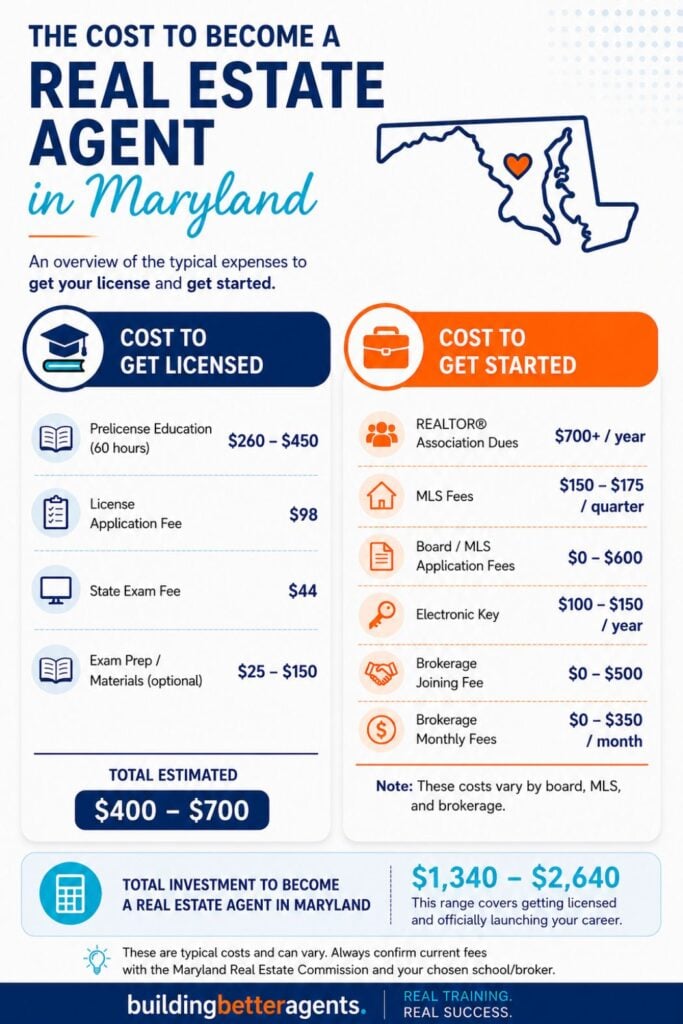
- Pre-License Real Estate Course – $260 to $450
- Application Fee – $98
- State Exam Fee – $44 (per attempt)
- State exam prep courses or materials – $25 to $150 (optional)
** Total Cost to Get Licensed = $400 to $700
More Costs to Expect as a Maryland Realtor
There are several other expenses to consider when becoming a real estate agent. Whether you’re building a new business and opening a gift shop, restaurant, or your real estate empire, keep in mind there are always start-up costs involved.
To follow are some of the most common costs you’ll incur:
Additional Costs to Budget For
| Expense | Estimated cost |
|---|---|
| Post-license continuing education | Approximately $100–$250 |
| License renewal | $78 every two years |
| Local, state, and national REALTOR® associations | Often $700 or more per year, depending on the association. See examples below. |
| Multiple Listing Service (MLS) | Approximately $150–$175 per quarter |
| Application fees for a local REALTOR® association or MLS | Approximately $0–$600 |
| SentriLock or Supra eKEY access | Approximately $100–$150 per year |
| Brokerage joining fee | Typically $0–$500, with approximately $250 being common |
| Monthly brokerage fees | Approximately $0–$350 per month |
| Business cards and listing signs | Varies based on the brokerage and the materials purchased |
| Advertising and marketing | Varies based on how the agent chooses to promote their business |
Examples of Maryland REALTOR® Association Dues
| Association | Estimated dues |
|---|---|
| Southern Maryland REALTORS® | Approximately $1,017 per year |
| Pen-Mar Regional Association of REALTORS® | Approximately $767 per year |
| Greater Baltimore Board of REALTORS® | Contact the association for current membership options and pricing |
| Anne Arundel County Association of REALTORS® | Approximately $969 per year |
| Greater Capital Area Association of REALTORS® (Bethesda area) | Approximately $742 per year |
| Coastal Association of REALTORS® | Approximately $1,040 per year |
When you combine the expenses required to earn your license with the initial costs of officially launching your real estate business, here’s how it all adds up:
Total estimated cost to become a real estate agent in Maryland: $1,340–$2,640
Learn more about costs to become a real estate agent in Maryland:
Find the Best Online + In Person Real Estate Schools
To get your real estate license, you’ll have to attend a school that’s approved by the Maryland Real Estate Commission. There are at least a dozen approved real estate schools throughout the state. Some are online, others in person, and a few do a combination of the two. Please note that a few of these schools are our affiliate partners, so we may earn commission, as no additional cost to you!
Here are a few of the most popular:
- Colibri Real Estate (online)
- Kaplan Real Estate Eduation (online + live instructor virtual sessions)
- Maryland Elite Learning Academy (online, zoom and classroom)
- McKissock Learning (online)
- Maryland Real Estate Academy (online and in person)
- The CE Shop (online + exam prep)
When shopping for the best schools in Maryland, you’ll want to compare pricing, but there are a few other things you will need to consider:
- Are practice exams given to the students or is there any additional charge?
- Do they share their “pass rate”? This will tell you what percentage of their students passed the state exam on the first try.
- Does the real estate school offer any guarantees or refunds if you don’t pass the state exam?
- Do they offer a separate exam prep course or a weekend cram course?
How to Select a Maryland Real Estate Broker
In Maryland, you must affiliate with a real estate brokerage in order to apply for your real estate license and actively help people buy and/or sell property. The real estate commission often refers to the brokerage firm as the “sponsoring broker.” Doing your homework to select the right brokerage to work with can be critical to your success as a newly licensed agent.
When researching and meeting with different brokerages, keep in mind that many are independently owned franchises. So one Keller Williams or Sotheby’s office could be completely different from another that’s just 10 minutes away. The culture, training, support team, and sometimes even the fees and commission splits can vary from franchise to franchise.
PRO TIP: Don’t worry about commission splits, focus on SUPPORT.
While many newly licensed agents are looking for the best commission splits when shopping for brokers, we would highly recommend that you make that #2 or #3 on your list. The most important thing you should look for in a brokerage is how they support brand new real estate agents. Do they have a formal training program? Will you have at least 3 people you can reach out to if you have questions? Are they available outside traditional business hours? Do they have mentors – and what exactly will the mentors do to assist you?
How to Become a Real Estate Agent in Maryland: FAQs
You can pass the exam without a broker, but MREC will not issue an active license until a licensed Maryland broker submits a commitment to sponsor you. If you pass the exam without a broker, your application sits in “inactive” status. You have one year from your exam pass date to affiliate with a broker and activate your license. Learn how to find the best broker (20 key questions to ask!).
In order to become a real estate broker in Maryland, you must have an active real estate salesperson license for at least (consecutive) three years before applying to become a broker. You will also have to complete a 135-hour Broker pre-licensing course is also required and pass the state broker examination.
If you ask other real estate agents, most will describe the Maryland real estate licensing exam as “not so easy.” There are 110 multiple choice questions, 80 on the National portion and 30 on the State portion. You’ll have 90 minutes to take the National and 30 minutes to take the State portion and pass with a minimum score of 70%. For more information about the state exam, download the PSI Candidate Information Bulletin.
Don’t worry! It’s not uncommon for people not to pass the exam on the first try. If you fail the exam, simply submit a new request to the PSI testing site. After that, you can schedule a new appointment to retake the examination. The fee is $44 per attempt and there is no limit to the number of times you can retake the exam.
While you can take the 60-hour pre-licensing coursework online, Maryland requires the course’s final exam to be proctored. Most approved online providers offer virtual proctoring (via webcam) so you can take it from home, but you must ensure your chosen school includes proctoring in its package price.
No. Maryland requires all candidates to take the official state licensing exam in person at an authorized PSI testing facility (locations include Baltimore, College Park, Crofton, Hagerstown, Salisbury, and Lanham).
You do not need to retake the entire exam. The test consists of two parts: National (80 questions) and State Law (30 questions). If you pass one section, you only need to reschedule and retake the specific section you failed, paying a reduced re-examination fee to PSI.
Math accounts for roughly 10–15% of the National portion (calculating commissions, prorated taxes, loan-to-value ratios, and square footage). You do not need advanced math or a financial calculator. PSI provides a basic, non-programmable, four-function calculator at the test center.
Realistically, 3 to 6 months. Completing the 60-hour course takes 3–6 weeks depending on pace. Scheduling and passing the exam takes 1–2 weeks. Licensing and broker onboarding take another 2 weeks. Since real estate transactions average 30–45 days to close, plan for a few months of runway before your first commission check arrives.
Maryland Real Estate Commission requires that Sales Agents and Associate Brokers complete 15 hours of continuing education (CE) each renewal cycle. As of the current requirements, this breaks down into six required topic areas: 3 hours of Legal & Legislative Update, 3 hours of Ethics, 3 hours of Brokerage Relationships & Disclosures, 1.5 hours of Fair Housing, plus 4.5 hours of electives to round out the full 15. Brokers, branch office managers, and team leaders also have 90 days after taking on that role to complete an additional 1.5-hour course.
Not automatically, but Maryland has reciprocity arrangements and simplified waiver paths. If you hold an active Maryland license, you can apply for a Virginia or DC license by reciprocity, which typically requires passing only the State portion of their exams and completing a brief state-specific law course rather than repeating the entire 60-hour pre-licensing program.
A past criminal record or financial setback doesn’t automatically disqualify you. The Maryland Real Estate Commission (MREC) evaluates applicants on a case-by-case basis under their “good character and reputation” requirement. Felony convictions, misdemeanors related to fraud or theft, and recent financial crimes face heavier scrutiny. You can submit background documentation to MREC for review before investing in coursework.
A Standard Residential License allows you to perform both residential and commercial real estate transactions in Maryland. A Commercial-Only License strictly limits you to commercial properties. Most new agents should select the standard residential/general salesperson license to maintain full transactional flexibility.
Great question. It really just depends on how you’d like to use your license. If you just want to sell a few homes each year to friends and family, you’ll have to crunch the numbers to see if the cost of getting and maintaining your Maryland real estate license is worth it. As you can tell by the fees listed earlier, it is an investment. For example:
Let’s say you sell two Baltimore homes at $375,000 each. You’ll earn approximately $15,000 after broker commission splits. If you paid $3,200 in Board Dues, MLS fees, marketing brochures, broker monthly fees, business cards, etc, you would net about $12,500 (before taxes).
If you plan to jump in and make a career in selling homes in Maryland, then absolutely! The real estate market is fair to good, depending on your specific area. It can be a challenge moving from a salaried position to a commission-based business, so it’s important to have at least six months of savings in the bank. If you don’t have that yet, then you may want to keep your current job for a short period of time as you lay the foundation for your new real estate business.
Is Getting a Real Estate License Worth It?
Great question. It really just depends on how you’d like to use your license. If you just want to sell a few homes each year to friends and family, you’ll have to crunch the numbers to see if the cost of getting and maintaining your Maryland real estate license is worth it. As you can tell by the fees listed earlier, it is an investment. For example:
Let’s say you sell two Baltimore homes at $375,000 each. You’ll earn approximately $15,000 after broker splits. If you paid $3,200 in Board Dues, MLS fees, marketing brochures, broker monthly fees, business cards, etc, you would net $12,800 (before taxes).
If you plan to jump in and make a career in selling homes in Maryland, then absolutely! The real estate market is booming. It can be a challenge moving from a salaried position to a commission-based business, so it’s important to have at least six months of savings in the bank. If you don’t have that yet, then you may want to keep your current job for a short period of time until you lay the foundation for your new real estate business.
Other Articles + Resources You Might Like:
- 20 Questions to Ask When Choosing a Brokerage
- What You Can Do BEFORE You’re Officially Licensed (free guide)
- Should New Agents Join a Real Estate Team?
- Maryland Real Estate Commission
- Real Estate Stats and Average Home Sales Prices in Maryland
- Complete list of REALTOR Boards and Associations in Maryland
- More advice for new real estate agents