

Please note: This website contains affiliate links. As an Amazon Associate, we earn from qualifying purchases at no additional cost to you.
A few years ago, online reviews were mostly about impressing people.
Now they’re also impressing machines — and that changes things for your business more than you might expect.
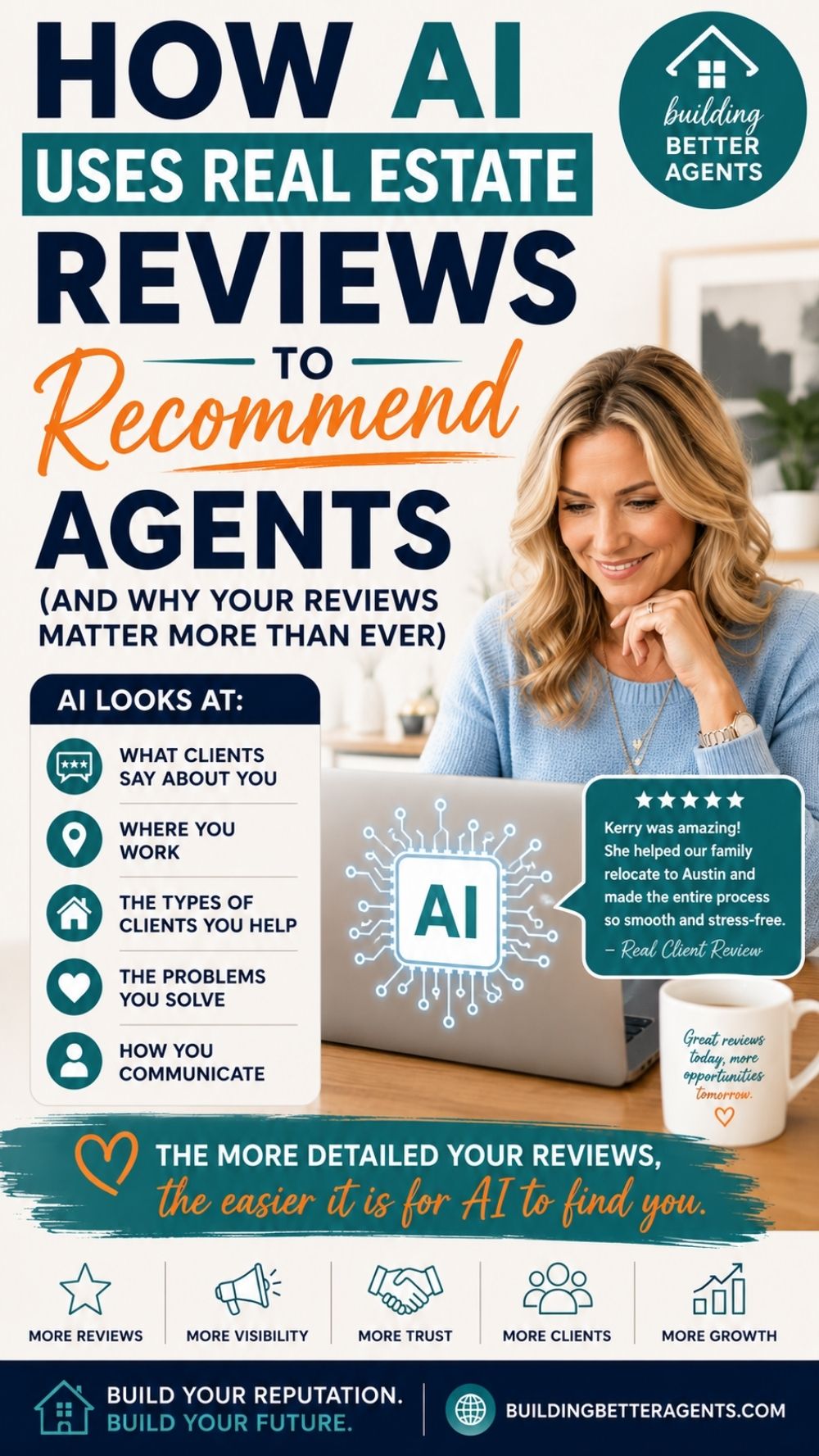
When someone types “best real estate agent near me” or “top listing agent in Austin TX” into ChatGPT, Google AI, Claude or Gemini, those tools aren’t just scanning websites anymore.
They’re reading your reviews.
Not just your star rating or how many you have — the actual words inside them. The stories your clients tell, the neighborhoods they mention, the types of transactions they describe.
In other words, AI is quietly building a profile of you as a real estate agent (or broker) based on everything people publicly say about working with you.
And most agents have no idea this is happening yet.
Wait… AI Is Reading My Reviews?
Think about how you already use tools like ChatGPT in your own life.
Maybe you’ve asked it which treadmill to buy, where to travel, or which coffee maker has the best reviews. When AI gives you a recommendation, it doesn’t randomly guess — it pulls from reviews, websites, forums, articles, and public content across the web, then looks for patterns in what people consistently say.
Real estate is moving in exactly the same direction. When someone asks AI “who’s a good Realtor in Nashville for first-time buyers?”, the system is trying to figure out which agents consistently work with that type of client, which neighborhoods they know, what past clients say about the experience, and whether the agent appears active and trustworthy. Your reviews are one of the primary inputs feeding that process.
QUICK EXAMPLE:
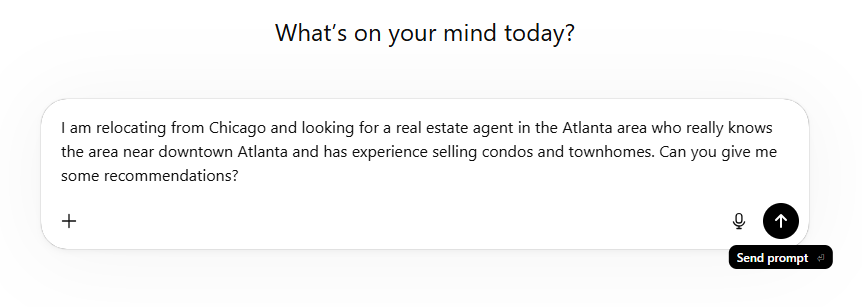
I went into “incognito mode” on my browser and asked ChatGPT this…
It came back and recommended two boutique-style brokerages, a real estate team and three (3) individual real estate agents… and they were all pretty solid recommendations!
ChatGPT also included links to the brokerage and team websites, but for the individual Realtors, it linked directly to their ZILLOW reviews.
Whatever market you are in, you need to try this!
AI Doesn’t Just See Stars — It Sees Context
Here’s the thing most agents miss: a five-star rating alone doesn’t tell AI very much. A string of “great experience, highly recommend!” reviews is almost invisible to these systems because there’s nothing specific enough to work with.
But a review that says “Kerry helped us relocate from Detroit to Tampa, navigated a crazy multiple-offer situation, and found us a home near great schools for our kids” — that’s a completely different story. From that one paragraph, AI can understand that this agent works with relocation clients, knows the Tampa market, handles competitive offers, and serves family buyers who prioritize school districts.
The more detailed your reviews are, the more clearly AI understands what kind of agent you are — and the more confidently it can recommend you when someone’s search matches your strengths.
Your Reviews Are Becoming Part of Your Digital Reputation
AI doesn’t just look at one review in isolation. It looks at the overall story your entire online presence tells — your Google reviews, your Zillow profile, your website bio, your social media, even how you respond to reviews.
It’s connecting all of those pieces together to form a picture of your business.
When those platforms consistently reinforce the same themes — luxury homes, relocation expertise, first-time buyers, a specific neighborhood or city — AI becomes more confident recommending you for those types of searches.
Think of it this way: AI is trying to figure out what lane you own. The more consistently and clearly you signal that across your online presence, the more visible you become to the people looking for exactly what you do.
Google Reviews and Zillow Reviews: Why You Need Both
Many agents focus heavily on one platform and neglect the other. That’s leaving real opportunity on the table, because the two serve different purposes in how AI understands your business.
Google reviews primarily establish local credibility — they signal that you’re a real, active business that people in your community trust. Zillow reviews, on the other hand, speak to transaction-specific experience. They show that you actually close deals, navigate real estate situations, and deliver results for clients. Together, they paint a much more complete picture than either one can alone. If you’ve been putting all your energy into one, it’s worth giving some attention to the other.
PRO TIP: While Google and Zillow reviews are key, don’t forget about reviews on your Realtor.com profile.
Review Frequency Matters Less Than You Think
A lot of agents stress about the gap since their last review, worried that a quiet stretch will hurt them. In most cases, it won’t — at least not for the reasons they think.
What AI actually cares about is the quality and specificity of what’s there, whether your business still appears active across your profiles, and whether your online presence is consistent. A detailed, story-driven review from last year is often far more valuable than a vague “five stars!” from last week.
Frequency only becomes a real issue when a profile looks completely abandoned for years. So don’t let the fear of an imperfect review timeline stop you from catching up. Focus on building meaningful reviews steadily over time, and don’t panic if they don’t come in on a perfect schedule.
Responding to Reviews Matters More Than Ever
This is probably the biggest missed opportunity in real estate marketing right now. Most agents either never respond to reviews at all, or fire off a quick “Thanks so much!” and move on. But your responses are actually feeding AI fresh information about your business — and most agents have no idea they’re sitting on such an easy win.
Instead of a generic thank-you, try something like: “It was such a pleasure helping your family relocate to Denver and navigate such a competitive spring market. I’m so happy we found the right home near the schools you wanted.”
Now your response has added Denver, relocation, competitive market expertise, family buyers, and school-focused searches to your public profile — all from one reply.
The best part? This works on old reviews too.
Going back and thoughtfully responding to reviews from two or three years ago still creates fresh activity on your profile today. Clients don’t find it strange — most are genuinely pleased that you took the time.
If You Have Old Reviews Without Responses, Go Back and Reply
Seriously, this is LOW-hanging fruit.
If you have a backlog of unanswered reviews, spending an hour working through them is one of the highest-return things you can do for your online presence right now.
Thoughtful, specific responses reinforce your expertise, show professionalism to anyone reading your profile, and give AI more signal about who you are and what you do — all at the same time.
The goal with each response is to sound like a human being, not a press release. Mention something specific about the transaction, name the neighborhood or city naturally, call out the win you helped them achieve, and close warmly.
Here’s a core template to work from:
“Thank you so much for taking the time to leave this — it truly means a lot. It was such a pleasure working with you through [transaction situation], and I’m so glad we were able to [specific win]. I hope you’re settling in beautifully in [neighborhood/city] and loving every minute of it. Wishing you all the best in your new home!”
Not sure how to adapt your reply for different situations?
Here are a few ready-to-use versions:
- Buyer in a competitive market: “Thank you so much for this kind review! Helping you navigate such a competitive market was no small feat, and I’m so proud we were able to win that offer in [neighborhood]. I hope you’re completely settled in and loving your new home!”
- First-time homebuyer: “This made my day — thank you! Walking alongside you as a first-time buyer is one of my favorite things to do, and watching you get the keys to your home in [neighborhood/city] was such a rewarding moment. I hope you’re loving every square foot!”
- Seller with a strong result: “Thank you so much for trusting me with your home sale! Getting you [over asking / multiple offers / a quick close] in that market was a team effort, and I’m so glad it paid off for you. Wishing you all the best in your next chapter!”
- Relocation client: “Thank you for this! Helping your family make such a big move to [city/neighborhood] was genuinely one of my favorite transactions. I hope you’re all settled in and feeling right at home. Welcome to the area!”
- Difficult transaction or problem solved: “Thank you so much for this thoughtful review — it really means everything. I know our path to closing wasn’t the smoothest, but getting you through [inspection issues / repair negotiations / the appraisal gap] and across the finish line was absolutely worth it. So happy for you!”
Notice what every one of these responses has in common:
- a specific detail
- a neighborhood or city
- a genuine moment of warmth
That combination is exactly what makes a response useful to both the person reading it and the AI systems scanning it.
The Reviews That Help Most Include Specific Details
When you ask clients for reviews, it helps to gently guide them toward the kind of detail that actually makes a difference.
The reviews that work hardest — for both humans and AI — tend to mention specific neighborhoods or cities, the type of transaction, challenges you helped them solve, how you communicated under pressure, and what the experience felt like emotionally. You don’t need to script it for them.
Often just saying “feel free to mention the neighborhood and anything specific I helped you navigate” is enough to shift a generic five-star review into something genuinely useful.
Should You Worry About Getting Too Many Reviews at Once?
No. A lot of agents hesitate to reach out to past clients all at once, worried it will look suspicious to Google or Zillow.
In practice, both platforms understand that agents sometimes let reviews slide and then make a concerted effort to catch up. As long as the reviews are genuine, you’re fine. If you’ve neglected this for a while, don’t let that fear keep you stuck — just start asking.
What AI Cannot See
Here’s something worth sitting with for a moment: AI cannot see how hard you work. It has no idea how many late-night calls you took, how many anxious buyers you talked off the ledge, or how much you genuinely care about the people you serve. It can’t measure your hustle, your heart, or your intentions. It can only read what’s publicly written.
That’s not a flaw in the technology — it’s just the reality of how these systems work. And it means your reviews are no longer just a “nice to have.” They are, increasingly, the primary way AI forms an opinion about you before any potential client ever picks up the phone.
Real Estate Marketing Is Quietly Changing
For years, the dominant question in online marketing for agents was: “How do I rank number one on Google?” That question isn’t going away, but a new one is emerging alongside it: “How do I become the agent AI recommends?” And those are two meaningfully different challenges.
The agents who will win in this next phase are the ones building clear digital authority — strong, consistent profiles, detailed client reviews, and a recognizable area of expertise that AI can latch onto and trust. The good news is that most agents are still behind on this. Which means there’s a real window right now for anyone willing to put in the work before the rest of the market catches on.
What You Should Do Next
None of this requires a big overhaul or a marketing budget. It’s mostly about being intentional with things you’re probably already doing.
Start by asking more clients for reviews, and encourage them to be specific — neighborhoods, transaction types, challenges you solved together. Focus your energy on Google and Zillow first, since those carry the most weight.
Go back and respond to reviews you’ve left unanswered, even old ones, with specific language that reinforces your expertise. And take a look at your profiles and bios across platforms — consistency in how you describe yourself and your specialties matters more than most agents realize.
Because whether we like it or not, AI is becoming part of how buyers and sellers find their next agent. And your reviews are increasingly the first thing telling your story — before you ever get the chance to speak for yourself.
Please note: This website contains affiliate links. As an Amazon Associate, we earn from qualifying purchases at no additional cost to you.