

Please note: This website contains affiliate links. As an Amazon Associate, we earn from qualifying purchases at no additional cost to you.
If the thought of taking your state real estate exam makes your stomach drop, take a deep breath—you are far from alone.
Between the legal jargon, the math, and the sheer volume of information, it’s completely normal to feel overwhelmed. But here’s the good news: this test isn’t designed to trick you, and with the right strategy, it is 100% pass-able.
Consider this your complete, stress-free guide to crossing the finish line. We’ll walk you through exactly what’s on the exam, what to bring on test day, how to study on any budget, and even what to do if things don’t go as planned on your first try.
You’ve got this, and we’re here to help you get through it.
What’s Actually on the Real Estate Exam?
Every state real estate exam is split into two parts:
- A national portion — typically 80 to 100 multiple-choice questions on topics that apply no matter where you’re licensed: property ownership, contracts, agency relationships, financing, and fair housing.
- A state-specific portion — usually 30 to 50 questions on your state’s own real estate laws and regulations.
Put together, most candidates are looking at somewhere between 100 and 150 total questions and roughly three to four hours to finish.
Passing scores commonly fall between 70% and 75%, though the exact number — and whether you need to pass each section separately or just the combined total — varies by state. Your official candidate handbook (we’ve linked every state’s below) will tell you the exact numbers for where you’re testing.
What to Bring & What to Expect on Test Day
A little logistics prep goes a long way toward keeping exam-day nerves manageable:
- Valid, government-issued photo ID — a driver’s license or passport. No exceptions.
- A basic, non-programmable calculator for the math questions, if your state’s testing provider allows one. Check your candidate handbook — some testing centers provide an on-screen calculator instead.
- Scratch paper is provided — you generally can’t bring your own notes or study materials into the room.
- Personal items stay outside the testing room — phones, bags, and study aids are usually left in your car or a provided locker.
- Dress in layers — testing centers run unpredictably warm or cold, and you can’t control the thermostat.
- Arrive early — most centers require check-in before your scheduled time, and arriving late can mean forfeiting your slot.
How to Study for the State Real Estate Exam
Before you spend another dollar, check what you already have.
Some prelicensing courses include a bit of exam prep and study guides built in; a few include of the schools also give you a full dedicated exam prep package. Log back into your course dashboard and look before assuming you need to buy something separate.
If the course you took for your pre-license class just wasn’t clicking with you — or didn’t include exam prep at all — that’s completely normal, and it doesn’t mean starting over. Buying an exam prep / study guide tool from a different real estate school with a different teaching style, may help you sail through that exam.
Every option below is a standalone exam-prep product. You can buy any of them regardless of which company you took your actual licensing course through.
Real Estate Exam Prep Classes, Sample Tests + Tools
- PrepAgent via AceableAgent – a dedicated exam-prep add-on built around their mobile-first platform.
- The CE Shop – exam-prep bundle sold separately from their prelicensing courses.
- Colibri Real Estate – standalone exam-prep package, live-format study options.
- ExamScholar – the budget-friendly pick of the group.
Audio & Mobile-Friendly Options
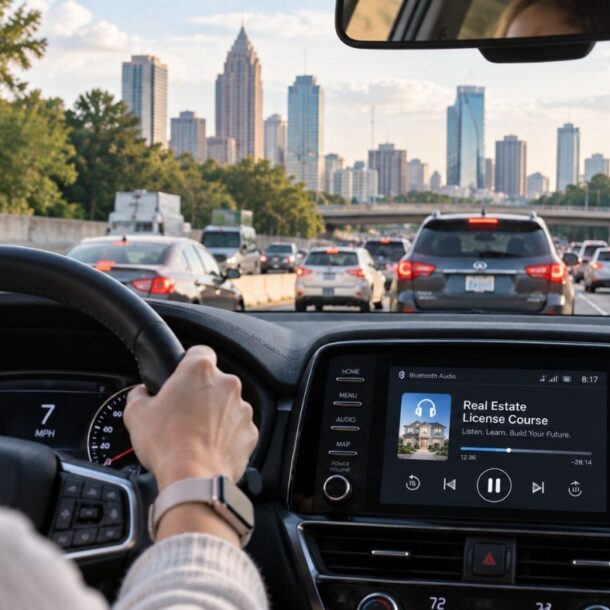
If you learn better by listening — on your commute, during a workout, wherever — these are built for that:
- PrepAgent – mobile app built around audio-friendly review.
- RealEstateU – another strongly mobile-friendly option for studying on the go.
- Audible – general real estate exam audiobooks covering the national portion. This is a third-party bookstore, not a licensing school, so it won’t cover your state-specific law section. See what’s available (several are completely free if you already have an audible account)
Free Resources
If budget is tight, YouTube has a genuinely useful amount of free real estate exam prep content — walkthroughs of key concepts, practice question breakdowns, and channels dedicated entirely to licensing exam prep.
Why Good Study Materials Aren’t Always Enough
Here’s something that catches a lot of well-prepared candidates off guard: even with a great study plan, the exam’s format can trip people up as much as the material does.
Most real estate exam questions have two or three technically-true answer choices — only one is the best, most complete answer to what’s actually being asked. Small words like NOT, EXCEPT, and BEST can flip an entire question, and scenario questions test whether you can identify the right party and the right timing, not just the right fact.
That’s a different skill than studying content, and it’s worth its own focus. We break down the specific traps, trigger words, and test-day tactics candidates wish they’d known going in in our guide to real estate exam practice questions and what to expect on test day.
Your State’s Official Real Estate Exam Handbook
The real estate commission or licensing division in every state publishes an official candidate handbook covering the exact format, timing, and study outline for its real estate license exam.
It’s the single best source for what your specific test will actually look like — more reliable than any third-party guide (including this one!). Find your state below and get your free download:
So… What Happens If You Don’t Pass the Exam?
Failing your first attempt doesn’t mean starting your licensing process over. Every state has a retake process — you’ll pay a rescheduling fee and pick a new test date, typically within a short waiting period.
Many states let you retake only the section you failed rather than the entire exam if the national and state portions are scored separately, so check your candidate handbook for your state’s specific retake rules before you panic.
If you do have to retake it, that’s exactly the moment to revisit the study option that’s clicking least for you and try a different standalone exam prep tool, study guides or practice tests from the list above.
And honestly, a different format might be all it takes to get you to ace that exam!
Please note: This website contains affiliate links. As an Amazon Associate, we earn from qualifying purchases at no additional cost to you.