


Please note: This website contains affiliate links. As an Amazon Associate, we earn from qualifying purchases at no additional cost to you. Learn more.
A free 7-page fillable guide for real estate agents to assess your market numbers, double down on your wins, and set some simple goals for 2027.
For many real estate agents and brokers, looking back at the past 12 months feels a little intimidating.
Between shifting interest rates, low inventory, and the client who texts at 9 p.m. with full-blown anxiety, this market has required every ounce of energy you’ve got. When you’re constantly fighting fires just to keep deals together, there’s rarely a quiet moment to stop and ask:
What actually worked, and what just drained my bank account and my energy?
So most of us skip the reflection, take a breath over the holidays, and hope January brings fresh momentum. But without taking a clear look in the rearview mirror, we run the risk of repeating the exact same stress—and spending money on the exact same dead-end leads—all over again.
That’s why we built this free 7-page Year-End Review & 2027 Planning Guide.
Whether this was your hardest year on record or a surprisingly solid one, putting your numbers on paper does something powerful: it takes the emotion out of the story. A quiet quarter stops feeling like a personal failure, and you can clearly see which daily habits actually moved the needle.
You don’t need to overhaul your entire life or fix 50 things at once. This fillable, step-by-step workbook will help you log your wins, pinpoint your highest-return lead sources, and pick just two simple focus areas for the next 90 days so you can enter 2027 feeling calm, clear, and fully in control of your time and income.
Why a Year-End Review Gives You Your Power Back
Real estate rewards activity, which makes it dangerously easy to confuse being exhausted with making progress.
When you put your year down on paper, the noise fades away and clarity takes over:
- It protects your hard-earned dollars: A big commission check can hide a lead source that cost more than it brought in. Seeing the true ROI on your spending keeps you from leaking money in 2027.
- It highlights the quiet wins: A slow market can make you feel like nothing worked, but your numbers will reveal the one or two simple habits (like hosting open houses or texting your sphere) that quietly produced results.
- It eliminates the emotional weight: Leaving the year in your head makes every slow week feel like a verdict on your career. Putting it on paper turns subjective fear into objective data.
Whether you’re finishing Year 1 or Year 15, this isn’t about judging your past performance—it’s about giving yourself a clean starting line and a clear, profitable plan for the year ahead.
5 Things to Look at Before You Set a Single Goal
Look at these five things first, because goals built on guesses fall apart by March. Each one has its own spot in the guide.
- Your numbers. Closings, volume, and GCI, plus the one most agents skip: what you actually netted after splits, fees, and expenses. GCI is the number you brag about. Net is the number you live on.
- Where your business came from. For each lead source that produced a closing, write down the closings, what you spent, and the GCI it earned. Your best and worst sources are usually a surprise. Need ideas for the weak spots? Start with our guide to lead generation for real estate agents.
- Your client conversion funnel. Four numbers: leads, real conversations, signed agreements, and closings. Whichever percentage is lowest is your leak. Can’t fill it in? Then your first goal is simply to start tracking.
- Your wins and lessons. A few honest prompts (your best moment, your biggest frustration, what you’d redo), plus a two-minute clean-up of the subscriptions you’ll cancel and the two tasks you’d hand off.
- Your brokerage. What you really paid, what that is as a percent of your GCI, and whether you’re getting it back in training, tools, and support. More on that below.
The 8-Area Business Health Check
Rate yourself from 1 to 5 in each of these eight areas, based on how your year actually went, not how you wish it went. A 1 means struggling, a 3 means okay but inconsistent, and a 5 means strong and working.
| Area | The question to ask yourself |
|---|---|
| Lead generation | Do I have a steady, predictable flow of new leads, or does it come in waves? |
| Conversion | Of the leads I get, how many become clients? Did my funnel show a leak? |
| Database and follow-up | Do I stay in touch with past clients and my sphere on a schedule, or only when I remember? |
| Value proposition and presentations | Can I clearly explain what I’m worth to a buyer or seller before they sign anything? |
| Marketing and online presence | Am I easy to find and consistent about showing up? Are my reviews and bio current? |
| Systems, tech, and AI | Do my tools save me time, or am I paying for apps I barely use? |
| Profitability | Do I know what I actually net per deal and which expenses are worth it? |
| Time and well-being | Do I have boundaries, time off, and energy left at the end of the week? |
Add up your score out of 40:
- 30 to 40: Strong foundation. Your growth is in the details, so focus on your lowest two.
- 20 to 29: Solid, with clear room to grow. This is where most agents land.
- Under 20: Great news. You now know exactly where to start, and every point you add will show up in your income.
Then circle your two lowest scores. Those are your focus areas for the year. Not eight. Two. Two things done well will change your year more than eight things done halfway.
Tempted to grade yourself generously? The guide includes three quick fact-checks to keep you honest: when you last cleaned your database, how many closings produced a review, and how many hours a week go to tasks that don’t make money.
How to Use the Guide in 90 Minutes
Work through it in three steps, in one sitting or two. Pour a coffee, be kind to yourself, and use estimates wherever you don’t have an exact number.
- Look back (about 40 minutes). Pages 2 and 3 cover your numbers, lead sources, funnel, wins and lessons, a quick clean-up, and the brokerage check-in.
- Find your focus (about 10 minutes). Page 4 is the health check. Score the eight areas and circle your lowest two.
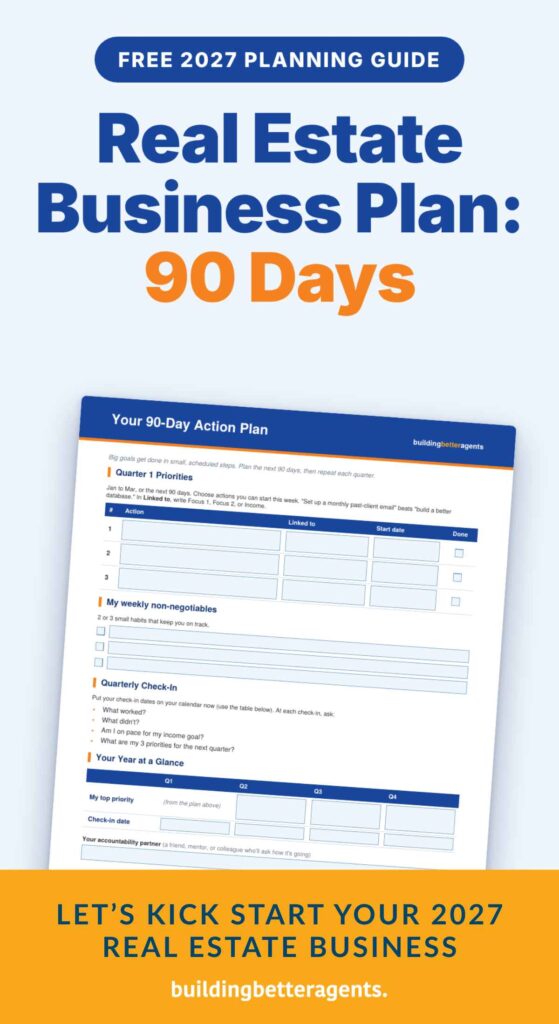
- Plan forward (about 30 minutes). Pages 5 and 6 turn your two focus areas into goals, an income target, and a 90-day action plan with a check-in date on your calendar.
If a blank doesn’t have an answer, leave it. A blank is information too. It usually points to the first thing worth tracking next year.
A Worked Example: From Income Goal to Conversations Per Week
The reverse math on page 5 turns a scary income number into a weekly habit. Here’s how it works with illustrative numbers. Yours will differ, which is why the guide pulls from the funnel rates you filled in on page 2.
| Step | Example |
|---|---|
| Net income goal | $100,000 |
| Average net income per closing | $5,000 |
| Closings needed | 20 ($100,000 ÷ $5,000) |
| Signed agreements needed | 25 (20 closings ÷ 80% agreement-to-close rate) |
| Real conversations needed | 250 (25 agreements ÷ 10% conversation-to-agreement rate) |
| Conversations per week | 5 (250 ÷ 50 weeks) |
A $100,000 year is a wish. Five real conversations a week is a habit. If your number comes out impossible for your schedule, change the income goal or the focus areas, not your sanity.
Should You Switch Brokerages? 5 Questions to Ask First
Your brokerage is your biggest business expense and your biggest business partner, so the new year is a fair time to ask what you’re getting for it. Start with the math: add up what you paid this year in splits, fees, and desk, tech, and E&O costs, then work out what that is as a percent of your GCI. Now answer these honestly with yes, not sure, or no:
- I know exactly how my split, cap, and fees work.
- What I pay is fair for what I get back.
- I get real training, support, and tools I actually use at my stage.
- Leadership is responsive, and I feel part of a community.
- My brokerage helps me grow, not just process paperwork.
Mostly yes? Stay put and use more of what you’re paying for. Mostly not sure? Spend 30 minutes this month getting your fee and split details in writing. Three or more no answers? It’s worth exploring, so talk to a few brokerages before you decide.
Before you ever switch, check your agreement for termination terms, how pending listings and referral fees are handled, and any non-compete or fee obligations. Timing matters.
Get the Free Year in Review + Year Ahead Guide
Ready to do this in 90 minutes? Grab the guide and block the time this week. You’ll get both versions: a fillable PDF you can type into on your laptop or phone, and a printable version for pen-and-coffee people.
Download the print-only version
Real Estate Agent Year End Review: Frequently Asked Questions
When should real estate agents do a year-end review?
Anytime in the last six weeks of the year or the first few weeks of the new one. Don’t wait for the perfect week. The guide is built to be finished in two sittings.
What numbers should a real estate agent track?
Start with closings, sales volume, GCI, and what you net after splits, fees, and expenses. Then track closings, spend, and GCI by lead source, and your funnel rates from lead to conversation to signed agreement to closing. Add more only if you’ll actually use them.
How many closings do I need to hit my income goal?
Divide your net income goal by your average net income per closing. The worked example above shows how to carry that all the way back to conversations per week.
I’m a new agent with very little data. Is this planner still useful?
Yes. Some numbers will be small or blank, and that’s fine. Your first goal might simply be to start tracking, and the guide tells you that in plain words.
Do I need to print the Year End Review workbook?
No. The fillable version lets you type straight into the boxes and save the file. The printable version is there if you’d rather write it out by hand.
Next Steps: Where to Go From Your Lowest Scores
Your two lowest health check scores tell you where to start, so go straight to the matching resources.
| If your focus is… | Start here |
|---|---|
| Lead generation and conversion | Lead Generation for Real Estate Agents |
| Database and follow-up | Sphere and Referral Marketing |
| Value proposition and presentations | Get More Listings, Building a Brand |
| Marketing and online presence | Online Marketing, Social Media, Video |
| Systems, tech, and AI | Leveraging AI |
| Profitability, time, and well-being | Real Estate Advice |
You did the hard part by stopping to look at your year. Most agents never do. Now pick your two, put your first check-in on the calendar, and go build a better year.
Please note: This website contains affiliate links. As an Amazon Associate, we earn from qualifying purchases at no additional cost to you. Learn more.