

Please note: This website contains affiliate links. As an Amazon Associate, we earn from qualifying purchases at no additional cost to you.
If you sell a $300,000 house, how much money do you actually make as the real estate agent?
You might assume there’s a simple answer. For example, 3% of $300,000 is $9,000, so the agent makes $9,000. Right?
Not necessarily.
That $9,000 may be the gross commission associated with your side of the transaction, but it isn’t necessarily what lands in your bank account. Your actual earnings can depend on your negotiated compensation, brokerage split, team or mentor fees, referral fees, and other costs associated with the transaction.
So, let’s walk through several examples to see what a real estate agent could actually earn on a $300,000 home sale.
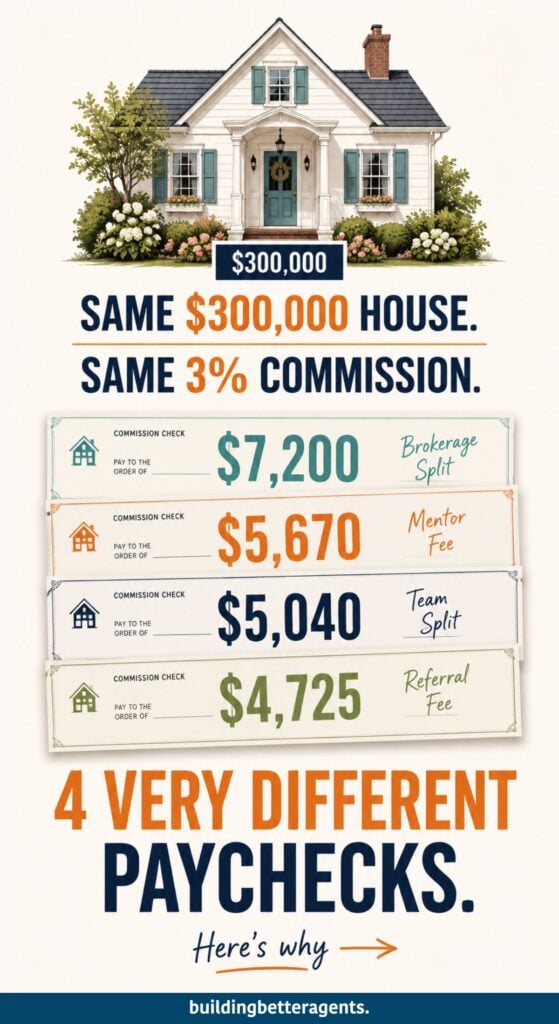
Quick Answer: If the compensation on a $300,000 transaction is 3%, the gross commission is $9,000. With an 80/20 brokerage split and no additional splits or fees, the agent would receive $7,200 before taxes and other business expenses. But change the compensation, brokerage split, or add a mentor, team, or referral fee, and that number can be considerably lower.
First, How Much Is the Commission on a $300,000 House?
There’s no standard real estate commission. Broker fees and commissions are negotiable and aren’t set by law.
That’s important because you can’t determine what an agent makes simply by knowing the home’s sale price.
For our examples, we’ll use three possible compensation amounts: 2%, 2.5%, and 3%. These are simply examples to demonstrate how the math works – they are not standard or recommended commission rates.
| 2% | 2.5% | 3% | |
|---|---|---|---|
| $300,000 sale | $6,000 | $7,500 | $9,000 |
At first glance, it would be easy to say that an agent made anywhere from $6,000 to $9,000 on the sale.
But we’re not done yet….
5 Things That Can Affect How Much a Real Estate Agent Actually Makes
There are several layers between the sales price of a house and the amount of money an individual real estate agent ultimately receives.
1. The Negotiated Commission
The first variable is the compensation negotiated for the agent’s services. It might be a percentage of the sales price, a flat fee, or another clearly defined amount depending on the agreement.
For agents working with buyers under NAR’s MLS policies, written buyer agreements must specify the compensation or how it will be determined, and the compensation can’t simply be an open-ended amount based on whatever a seller happens to offer.
For our $300,000 examples, we’ll stick with percentage-based compensation to keep the math easy to follow.
2. Your Brokerage Commission Split
This is one of the first things aspiring agents need to understand: the gross commission and the individual agent’s earnings aren’t necessarily the same thing.
Real estate agents generally work under a licensed real estate broker, and the agent’s compensation agreement with that brokerage determines how the commission is divided.
For example, suppose you have a 70/30 brokerage split.
That typically means:
- You receive 70%
- Your brokerage receives 30%
If the gross commission is $9,000, a simple 70/30 split would give you $6,300 and your brokerage $2,700.
Brokerage compensation models vary considerably. An agent might have a 50/50, 70/30, 80/20, or 90/10 split, for example. Some brokerages offer different structures involving caps, transaction fees, monthly fees, or other arrangements.
So when you’re comparing real estate brokerages as a new agent, don’t look at the advertised commission split in isolation. You need to understand the entire compensation structure.
3. Team or Mentor Fees
New agents sometimes have another person involved in their commission.
For example, your brokerage may have a mentoring program in which a portion of your commission from your first few transactions goes to your mentor.
If you join a real estate team, you may also have a separate team split. That means you could have a brokerage split and a team or mentor split affecting the same transaction.
These arrangements vary significantly, so always find out exactly how the split is calculated and in what order any deductions are made.
4. Referral Fees
Sometimes another real estate agent refers a client to you in exchange for a referral fee if the client ultimately closes a transaction.
For example, perhaps an agent in another state has a past client moving to your area. They introduce the client to you, and you agree to pay the referring brokerage 25% of the commission received from the resulting transaction.
We’ll show you exactly what that could do to a $300,000 sale in a moment.
5. Lead Generation and Other Transaction Fees
Referral fees aren’t the only additional expense that can come out of a transaction. Some third-party lead generation or referral programs charge a fee when a lead successfully closes. Depending on your brokerage, there may also be transaction, administrative, franchise, or other fees associated with a closing.
The exact fees depend on your brokerage, team, lead source, and agreements, which is why two agents can sell homes for exactly the same price and walk away with very different commission checks.
4 Examples of What an Agent Could Make on a $300,000 House
Now let’s put all of this together.
We’ll use the same 2%, 2.5%, and 3% compensation examples in each scenario so you can see how changing just a few variables affects what the agent receives.
These are simplified hypothetical examples. Actual brokerage, team, mentor, referral, and other agreements may calculate fees differently.
Example #1: 80/20 Brokerage Split With No Additional Splits
Let’s start with a fairly straightforward scenario.
The agent has an 80/20 commission split with the brokerage, meaning the agent receives 80% and the brokerage receives 20%.
There are no team, mentor, or referral fees in this example.
| 2% | 2.5% | 3% | |
|---|---|---|---|
| Gross commission | $6,000 | $7,500 | $9,000 |
| Brokerage gets 20% | −$1,200 | −$1,500 | −$1,800 |
| Agent receives | $4,800 | $6,000 | $7,200 |
So with 3% compensation on a $300,000 sale, this agent receives $7,200 before taxes and other business expenses.
Example #2: 70/30 Brokerage Split + 10% Mentor Fee
Now let’s look at a newer agent who has a 70/30 brokerage split and is also participating in a mentoring program.
For this hypothetical example, we’ll assume the mentor receives 10% of the agent’s portion after the brokerage split.
| 2% | 2.5% | 3% | |
|---|---|---|---|
| Gross commission | $6,000 | $7,500 | $9,000 |
| After 70/30 broker split | $4,200 | $5,250 | $6,300 |
| 10% mentor fee | −$420 | −$525 | −$630 |
| Agent receives | $3,780 | $4,725 | $5,670 |
At 3%, the gross commission is still $9,000. But instead of receiving $7,200 like the agent in our first example, this agent receives $5,670.
Again, mentor programs aren’t all structured this way. We’re simply using this example to demonstrate how another split can affect your commission.
Example #3: 70/30 Brokerage Split + 25% Referral Fee
Next, let’s say another agent referred the client and the agreed referral fee is 25%.
For this hypothetical example, we’ll deduct the referral fee from the gross commission and then apply the agent’s 70/30 brokerage split to the remaining amount.
| 2% | 2.5% | 3% | |
|---|---|---|---|
| Gross commission | $6,000 | $7,500 | $9,000 |
| 25% referral fee | −$1,500 | −$1,875 | −$2,250 |
| Remaining commission | $4,500 | $5,625 | $6,750 |
| Agent’s 70% share | $3,150 | $3,937.50 | $4,725 |
This is where the difference becomes much more obvious.
The original gross commission at 3% was $9,000, but after the referral fee and brokerage split, the agent receives $4,725.
Example #4: 70/30 Brokerage Split + 20% Team Split
Finally, let’s look at an agent who works on a real estate team.
Team compensation structures vary widely, so there isn’t one standard “team split.” For this simplified example, we’ll say the agent has a 70/30 brokerage split and then pays the team 20% of the agent’s remaining portion.
| 2% | 2.5% | 3% | |
|---|---|---|---|
| Gross commission | $6,000 | $7,500 | $9,000 |
| After 70/30 broker split | $4,200 | $5,250 | $6,300 |
| 20% team split | −$840 | −$1,050 | −$1,260 |
| Agent receives | $3,360 | $4,200 | $5,040 |
This is why it’s so important for a new agent considering joining a team to understand exactly how compensation works.
Don’t simply ask, “What’s my split?”
Ask what happens to a commission from beginning to end, including brokerage splits, team splits, fees, caps, lead fees, and any other deductions.
So, How Much Would You Make on a $300,000 House?
Let’s compare the 3% examples side by side.
Each agent sold a $300,000 property, and each example started with the exact same $9,000 gross commission.
| Agent Receives | |
|---|---|
| 80/20 brokerage split only | $7,200 |
| 70/30 split + 10% mentor fee | $5,670 |
| 70/30 split + 25% referral fee | $4,725 |
| 70/30 split + 20% team split | $5,040 |
That’s a range of $2,475 on the exact same $300,000 sale with the exact same 3% starting compensation.
And that’s why the question “How much does a Realtor make on a $300,000 house?” doesn’t have one universal answer.
Don’t Forget: Your Commission Check Isn’t All Profit
There’s one final distinction that’s particularly important for aspiring real estate agents.
The amount you receive from the transaction isn’t necessarily the amount you get to spend.
Many licensed real estate agents are treated as self-employed for federal tax purposes when the applicable IRS requirements are met.
Real estate agents can also have significant business expenses, which may include things like MLS and association fees, licensing and continuing education, marketing, signs, software, insurance, mileage, photography, and other costs of running their businesses.
So if an agent receives $7,200 from our first example, we wouldn’t describe that as $7,200 in profit or even necessarily “$7,200 take-home pay.”
It’s the agent’s commission after the splits we’ve included in that particular example — before considering taxes and other business expenses.
And that leads to an important question if you’re thinking about getting into the business: How do real estate agents actually get paid, and what can you realistically expect your income to look like?
FAQs About Real Estate Agent Commissions
Do real estate agents automatically make 3% on a sale?
No. There is no legally set standard commission rate. Real estate compensation is negotiable, so an agent’s compensation might be a percentage, flat fee, or another clearly defined amount depending on the agreement.
How much is 3% commission on a $300,000 house?
Three percent of $300,000 is $9,000. However, $9,000 is the gross commission in that example. The individual agent may receive less after brokerage splits, team or mentor splits, referral fees, and other applicable fees.
How much is 2.5% commission on a $300,000 house?
A 2.5% commission on a $300,000 sale is $7,500 before any applicable splits or fees.
How much is 2% commission on a $300,000 house?
Two percent of a $300,000 sale is $6,000 in gross commission. With an 80/20 brokerage split and no additional fees in our simplified example, the agent would receive $4,800.
Does the real estate agent get the entire commission?
Not necessarily. Depending on the agent’s compensation structure, part of the commission may go to the brokerage, team, mentor, referring brokerage, or other parties. That’s why it’s important to distinguish between gross commission and what the individual agent ultimately receives.
Do real estate agents get paid a salary in addition to commission?
Compensation arrangements can vary, but many real estate agents are paid based on sales or other output rather than hours worked. Qualified licensed real estate agents who meet the applicable requirements are treated as self-employed for federal tax purposes.
Final Thoughts
If you’re considering a career in real estate, understanding commissions is only one piece of the puzzle. Stay tuned for some more articles about how real estate agents get paid, when they receive their commission checks, what happens when a sale doesn’t close, and which expenses agents typically have to cover themselves.
Please note: This website contains affiliate links. As an Amazon Associate, we earn from qualifying purchases at no additional cost to you.