

Please note: This website contains affiliate links. As an Amazon Associate, we earn from qualifying purchases at no additional cost to you. Learn more.
Choosing a real estate broker is one of the most important decisions you’ll make early in your career — and it’s also one of the easiest to rush.
When you’re newly licensed, everything feels urgent. You want to get started, make money, and not fall behind. And because of that, many agents end up choosing a brokerage based on one thing: commission split.
The problem?
That decision often comes back to haunt them.
Behind the glossy presentations and big promises, brokerages can look very different once you’re actually working there. Support, training, culture, technology, mentorship, accountability — these are the things that shape your day-to-day experience far more than a few extra percentage points.
That’s why asking the right questions upfront matters so much.
This list isn’t about catching a broker off guard or grilling them in an interview. It’s about helping you understand what kind of environment you’re stepping into — and whether it truly supports the kind of agent you want to become.
Before you decide, we strongly recommend meeting with at least three different brokerages and doing your homework on each one. Once you’ve narrowed it down, these questions will help you move past surface-level answers and get real clarity on what’s actually being offered.
And as you’re doing your research, it’s also worth taking a look at newer brokerage models — including eXp Realty — to understand how different approaches to training, support, and agent independence compare.
The right brokerage won’t just help you start your career.
It will help you stay in the business.
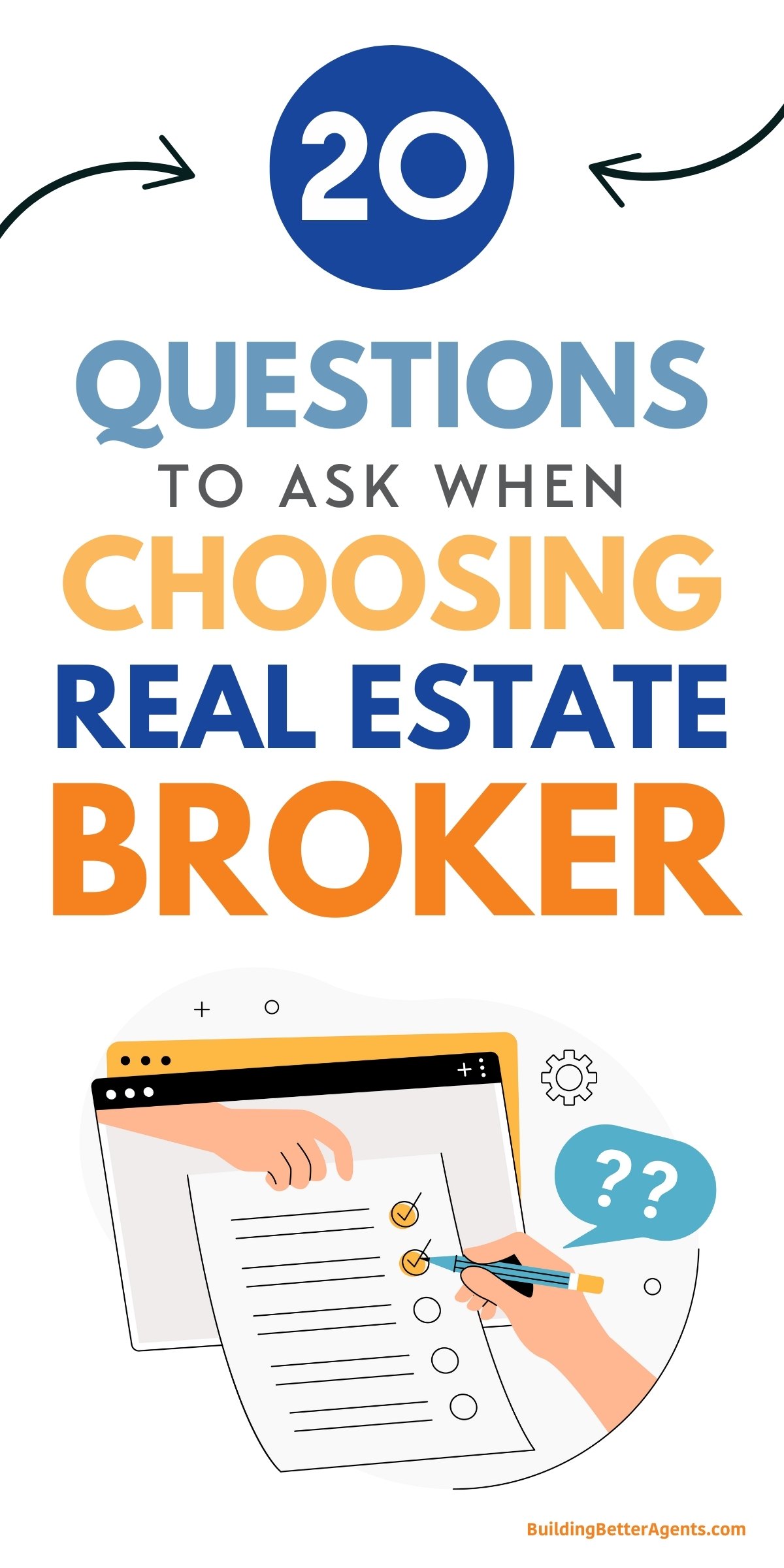
Ask These 20 Questions When Choosing a Real Estate Broker
FINANCIAL
1. What are your commission splits? (i.e. does the broker get 40% and you take 60% of the commission earned)
2. Are there any franchise fees? Many large real estate brokerages charge a 3% to 8% “franchise fee” on top of the commission split above, so using the example above, the broker would receive 40%, the franchise fee would be 5% and you would receive 55%).
3. Do you offer a commission cap? A commission cap is the maximum amount of commission that the brokerage will keep each year. For example, if the “cap” is $20,000 and you generate $200,000 in gross commission, you will net $180,000. If an agent cap is NOT offered and you are on a 60 / 40 commission split, then $80,000 would go to the broker and you would net $120,000.
4. Are there any other brokerage-related fees? A few common ones include:
- Monthly office fee
- Monthly MLS fee
- Errors and Omissions Insurance (E&O)
- Education fee (often charged for the new licensee course they offer)
- Start-up fee
- Desk fees
5. What other expenses might I be responsible for? Examples include:
- Lockboxes
- eKey (to access property lockboxes)
- Signage
- Business cards
- REALTOR designation (usually $400+ per year)
- Website hosting and IDX (MLS feed)
BROKER BENEFITS & OFFERINGS
6. Do you offer any of the following:
- Business Cards
- Signage
- Lockboxes
- Stand-alone website or page on broker’s website (FYI: a stand-alone is a big plus)
- Are homebuyer or home seller leads provided? If so, ask the following important questions:
- How are they distributed among the agents?
- Is there a referral fee or upfront charge?
- How many leads can I expect each week or month?
- Are the leads website registrations or are they actually inquiring about a specific property?
- What is the typical conversion rate on your leads (i.e. what percentage of the leads end up buying or selling)
- Closing Coordinator
- Technology support team
- Continuing education classes (for CE credits)
- eSignature tools – DocuSign, DotLoop, etc
- Paid At Closing option
- Customer Relationship Management (CRM) system
- Discounts with local vendors
- Marketing resources (try to get lots of details about what is available)
- Meeting space (to meet with your clients)
- Clerical or administrative support
EDUCATION & SUPPORT
7. What type of classes do you offer and how often? Also, ask if there is a cost for the classes. Many brokers offer lots of classes, but most are taught by agents in the office (i.e. your local competitors). The good classes that are taught by the brokerage may cost between $200 – $1,000 per class.
8. Are the classes all in person or do you offer online courses (that you can view at your convenience)
9. Who can I contact if I have questions about a contract? Are they available after 5 pm if I have an urgent issue?
10. Do you have a mentor program? If so, how does it work? Typically the agent mentor program will last for your first 3 to 6 months in the business (or the first few transactions) and you may share a percentage of your sales commission with your mentor in exchange for their guidance.
BROKERAGE ENVIRONMENT & EXPECTATIONS
11. How many real estate agents are in the office?
12. How often do you have team meetings, happy hours, lunch & learn sessions, etc?
13. Are there any meetings that are mandatory attendance?
14. What do you do to help promote our listings, the office, and the agents?
15. Is a desk or phone duty required for each agent? If so, how many hours a week?
16. How are you involved with the surrounding communities?
17. What are your expectations for me? Is there anything else that I’m required to do as an agent under your real estate brokerage? This could include selling a certain number of homes each year, being a full-time agent, attending certain meetings, etc.
COMPANY CULTURE
18. Can you describe the atmosphere of the office?
19. Would it be possible to get a tour of the brokerage and meet some of the agents and staff?
20. Can I have the phone numbers of 3 to 5 agents who work in the office? [It’s always beneficial to have a private discussion with the other real estate agents!]
BONUS: Can I sit in on an upcoming training session or team meeting?
Bonus Questions Most Agents Wish They’d Asked Before Joining
These bonus questions go beyond commission and fees. They’re designed to help you understand what your real, day-to-day experience will look like — not just in your first few months, but years down the road.
Long-Term Growth & Career Path
- What does support look like after my first year?
Many brokerages focus heavily on onboarding and initial training but offer little structure once agents are producing. Ask how support evolves as your business grows. - How do you support experienced agents who want to scale or streamline?
This helps you understand whether the brokerage is built only for beginners — or for long-term careers. - Are there opportunities to grow here without building a team?
Important for agents who want leverage, income diversification, or leadership without managing people.
Technology & Systems (The Real Questions)
- Which tools are included, and which ones will I still need to pay for myself?
This clarifies your true cost of doing business and avoids “tech stacking” overwhelm. - How often do your systems change, and how are agents trained when they do?
Constant platform changes without training are a major agent frustration. - Is your technology optional or required?
Some agents want flexibility; others want structure. This tells you how much autonomy you’ll actually have.
Marketing, Branding & Visibility
- How much control will I have over my personal brand and marketing?
This matters more as agents build visibility on social media and online. - What marketing support is included — and what’s DIY?
Ask for specifics, not buzzwords. - How does the brokerage help agents stay visible in slower markets?
This reveals whether the broker thinks proactively or only reacts when times are good.
Support When Things Go Wrong
- What happens when I have a contract issue at 7 p.m. on a weekend?
Not “who,” but how fast and how reliably support shows up. - How do you handle agent disputes, complaints, or difficult transactions?
This gives insight into leadership style and whether agents are protected or blamed.
Culture, Autonomy & Flexibility
- How do you balance independence with accountability?
A huge quality-of-life issue that often gets overlooked. - How are decisions made here — and how are agent voices included?
This tells you whether the culture is collaborative or top-down.
The Question Almost No One Asks (But Should)
- If this brokerage stops being the right fit in a few years, how easy is it to transition out?
A healthy brokerage won’t trap agents — and the answer to this question is very telling.
Final Thoughts
It can be hard to truly understand a brokerage’s culture from the outside. Office tours and interviews only show part of the picture — and that’s exactly why asking thoughtful questions upfront matters.
Real estate is an independent business, but it’s not meant to be a lonely one. Even the most self-sufficient agents need support when contracts get complicated, markets shift, or they’re ready to grow beyond where they are now. The right brokerage provides that support without limiting your independence.
Taking the time to evaluate training, mentorship, leadership, technology, and culture — not just commission splits — gives you a clearer sense of what your day-to-day life will actually look like once the excitement of joining wears off.
Choosing the right real estate broker won’t guarantee success.
But choosing the wrong one can make everything harder than it needs to be.
When you find a brokerage that aligns with how you want to work, learn, and grow, it doesn’t just support your business — it supports your confidence, momentum, and long-term happiness in this industry.
And that makes all the difference.
Editor’s note: This article was created by Kerry Lucasse, Founder of Building Better Agents and Realtor at eXp Realty. Information deemed reliable but is subject to change.
About Building Better Agents
At Building Better Agents, we are dedicated to helping agents build successful real estate careers. We help agents develop a plan, build a database, and work smarter to uncover the keys to success as a real estate agent. All without cold calling, door knocking, and chasing expired listings. Building Better Agents founder Kerry Lucasse is proud to be aligned with eXp Realty.
For more information, please contact us today!
PIN THIS IMAGE TO SAVE AND SHARE THIS POSTS!
Ready to get more from your brokerage? Learn why agents voted eXp Realty “Best Place to Work” by Glassdoor!
Please note: This website contains affiliate links. As an Amazon Associate, we earn from qualifying purchases at no additional cost to you. Learn more.