





Please note: This website contains affiliate links. As an Amazon Associate, we earn from qualifying purchases at no additional cost to you. Learn more.
If you’ve ever opened ChatGPT, asked it to write a real estate post or email, and immediately thought, “Yeah… that does NOT sound like me,” you’re definitely not alone.
Most real estate agents don’t avoid AI because they hate technology — they avoid it because the content feels stiff, generic, or way too salesy. And in a relationship-based business like real estate, sounding like a robot is a deal-breaker.
Here’s the good news: AI can sound like you.
But only if you show it how.
In this guide, I’ll walk you through exactly how to train ChatGPT to match your voice, using your own writing (or a style you admire), so every email, post, blog, or listing sounds consistent, human, and on-brand.
You’ll Learn How to:
- Train ChatGPT to write in your real voice so it matches your personal brand
- Find writing samples that help AI understand your brand tone
- Create a reusable brand voice prompt for all of your real estate marketing
- Use AI without sounding robotic, salesy, or off-brand
- Easily adjust AI output so it stays consistent with how you show up online
Why Tone of Voice Matters More Than Ever in Real Estate Marketing
Most agents are sharing similar information:
- Market updates
- Listing announcements
- Buyer and seller tips
What makes people choose you isn’t the information — it’s how you communicate it.
Your tone of voice:
- Builds familiarity with past clients
- Makes leads feel comfortable reaching out
- Helps people recognize your content instantly
- Keeps your marketing from blending in with every other agent online
AI doesn’t replace this — it amplifies it when used correctly.
What “Training” ChatGPT Actually Means (and What It Doesn’t)
Let’s clear something up first.
Training ChatGPT does not mean:
- Coding
- Programming
- Creating a custom AI model
- Paying for expensive software
What it does mean is:
- Giving ChatGPT clear examples
- Explaining how you normally communicate
- Correcting it when it misses the mark
Think of ChatGPT like a new assistant.
At first, it doesn’t know your style — but once you show it, things get much easier.
Step 1: Gather Writing Samples That Sound Like You
Start by collecting real examples of how you already communicate.
Good options:
- Email newsletters
- Past client emails
- Blog posts
- Instagram or Facebook captions
- Listing descriptions
- Buyer or seller guides
You don’t need a lot.
Three to five solid examples is more than enough.
👉 Tip: Choose writing that feels natural and conversational — not overly polished marketing copy.
Step 2: What If You Don’t Have Many Writing Samples (or You Just Don’t Love Your Writing)
This is very common, so don’t worry, we have a simple fix for you!
If you’re still building your voice, you can absolutely use someone else’s writing style as inspiration — as long as you’re borrowing the tone, not copying the content.
Good inspiration sources:
- A local agent you admire
- A top ranking team (anywhere in the country) that has a brand and style you love
- A real estate coach or educator
- Any brand whose voice feels friendly, confident, and approachable – even outside of the real estate industry
This helps ChatGPT understand the vibe you’re going for while you grow into your own voice.
Step 3: How to Share the Writing Samples with ChatGPT
Before pasting anything, always set context first.
Example setup message:
I’m a real estate agent and I want you to learn my natural writing style so you can use it in my future marketing — emails, social media posts, blogs, and listing descriptions.
Then paste or upload your writing samples.
Example:
Here are several examples of how I normally communicate with clients and followers. Please analyze these for tone, voice, sentence structure, and overall style.
Then paste in your samples of:
- Email newsletter or client communication
- Social caption
- Sample blog articles (2 to 3 examples)
(You can paste them all at once or in sections.)
PRO TIP: If you want to keep everything in one place, you can create a PDF with all of your samples. When you’re ready, just upload it into ChatGPT by clicking the + sign and select “Add photos & files.” I like to do it this way so I can easily refer back to the examples and update as needed.
Step 4: Ask ChatGPT to Analyze Your Voice First
This step is crucial — don’t skip it.
Example prompt:
Analyze the writing samples I shared and describe my tone of voice in detail.
Include things like:
- Overall tone
- Level of formality
- Sentence length
- Use of humor
- How I sound compared to a typical real estate agent
This does two things:
- Confirms whether ChatGPT understands your voice
- Gives you clarity on how your brand actually comes across
If the description feels accurate, you’re on the right track.
If not, add another example or clarify what feels off.
Step 5: Create Your “Tone of Voice” Master Prompt (Save This!)
This is where everything clicks.
Once ChatGPT understands your style, you’ll create a single reference prompt you can reuse for all marketing.
Example Master Tone Prompt:
Use the following tone of voice for all future content:

- Friendly, professional, and conversational
- Confident but not salesy
- Clear and direct, without jargon
- Sounds like a helpful local expert, not a pushy salesperson
- Warm, approachable, and trustworthy
- Uses short to medium-length sentences
- Occasionally conversational phrases, but not cheesy
- Always sounds human and natural

If content sounds generic or robotic, rewrite it to better match this tone.
You can paste this prompt:
- At the beginning of a new chat
- Or once in a conversation and then keep working inside it
This becomes your AI brand voice cheat sheet.
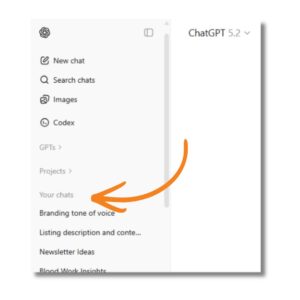
PRO TIP: You don’t have to remember to paste it in every time. When you need a new blog article or listing description created, just go into ChatGPT and find the last “chat” you had about that same topic. As long as you are in the same chat, the AI will remember your brand and tone of voice.
To find your previous chats, just go to the menu and you’ll see “Your Chats” about half way down….
Step 6: Using Your Voice for Everyday Real Estate Marketing
Now the fun part.
Social Media Example:
Using my tone of voice, write an Instagram caption announcing a new listing.
Keep it friendly, local, and informative — not salesy.
Email Example:
Write a short email to past clients about the current market.
Use my tone of voice and make it feel conversational and reassuring.
Blog Example:
Write a blog post for buyers explaining why interest rates matter.
Use my tone of voice and explain things in plain English.
Listing Description Example:
Write a listing description using my tone of voice.
Focus on lifestyle, not just features.
Avoid clichés like “won’t last” or “don’t miss out.”
Step 7: Refine the Tone (This Is Normal)
Your first draft won’t always be perfect — and that’s okay.
You can fine-tune with simple follow-ups:
- “Make this warmer and more conversational.”
- “Less promotional, more informative.”
- “Shorten the sentences.”
- “Sound more confident and less formal.”
- “Rewrite this to sound more like a real person.”
The more feedback you give, the better the output gets.
Common Mistakes Agents Make When Training AI
Avoid these pitfalls:
- Using only polished marketing copy as examples
- Giving too many conflicting writing styles
- Expecting perfection immediately
- Never correcting AI when it misses the tone
AI improves through interaction — not perfection.
How This One Step Improves All of Your Marketing
Once ChatGPT sounds like you:
- Writing emails feels easier
- Social media becomes less stressful
- Blog posts feel manageable
- Marketing feels consistent instead of scattered
You stop staring at a blank screen and start editing instead — which is where most agents thrive.
Final Thoughts: AI Should Sound Like You — Not Replace You
The best real estate marketing still feels human.
AI doesn’t change that — it just helps you scale it.
When ChatGPT understands your voice, it becomes a support tool, not a replacement. You still bring the personality, experience, and relationships. AI simply helps you show up more consistently.
If you’ve ever felt like marketing was heavier than it should be, this is the place to start.
FAQ: Training ChatGPT to Match Your Brand Voice
Do I need a clearly defined brand voice for this to work?
No. Even if you’ve never formally defined your brand voice, ChatGPT can learn it from how you naturally write and communicate.
What kinds of writing samples best represent my brand?
Use real emails, social media captions, blog posts, or listing descriptions — anything that sounds like you and reflects how you want your brand to feel.
How many writing samples should I give ChatGPT?
Three to five strong examples is usually enough. Consistency matters more than volume when training your brand voice.
Can I use someone else’s brand voice as inspiration?
Yes. You can model your tone after a brand or agent you admire, as long as you’re borrowing the style — not copying their content.
Will I need to retrain ChatGPT every time I create marketing content?
You won’t need to retrain it, but you should reuse your saved brand voice prompt in each new chat to keep your marketing consistent.
Can this brand voice be used across all marketing platforms?
Yes. Once ChatGPT understands your brand voice, you can apply it to listings, emails, social media, blogs, and client communication.
What if the content still doesn’t feel on-brand?
That’s normal. Give specific feedback like “more conversational,” “more polished,” or “less salesy,” and ChatGPT will refine the output.
Is using AI going to make my brand feel less personal?
Not when it’s done right. AI helps you scale your brand voice — it doesn’t replace your personality or relationships.
Please note: This website contains affiliate links. As an Amazon Associate, we earn from qualifying purchases at no additional cost to you. Learn more.